
Midlothian City Directory Collections
A Midlothian city directory search has a clear limitation at the outset: no official source located a complete local printed run, a reverse directory, or a confirmed local shelf of exact years. That gap matters. It is safer to name documented regional and archive routes than to imply a book exists for every Midlothian year. The useful collections below range from a regional telephone-book page to county-seat context and state archive catalogs. Each answers a slightly different question about a name, address, or era.
| Collection | Years | Where Held | Access |
|---|---|---|---|
| Midlothian-specific printed city directories | Exact runs not located | Local holdings unconfirmed | Ask the library before planning a visit |
| Greater Dallas White Pages | 1983, 1984/85, 1985/86 examples | UNT Portal to Texas History | Free digitized, page-level viewing |
| Northern Texas telephone exchange directory | 1885 example | Library of Congress guide/collection | Catalog or digital access; local completeness unconfirmed |
| Waxahachie city directories | 1895–96, 1907, 1922, 1927–28, 1942 | Sims Library/local materials | County-seat context, not a Midlothian directory |
| TSLAC city directories | Late nineteenth century onward, series-dependent | Austin print, microform, and catalog | Reading-room access; no remote staff searches |
| Ellis County records microfilm | Series and years vary | TSLAC, UTA Arlington, and depositories | Microfilm or interlibrary-loan route where available |
These are not a continuous publication sequence. A regional book can include a Midlothian-area route without being a full resident roll, and a Waxahachie volume should remain labeled as an adjacent county-seat resource. Exact local directory, obituary, newspaper, and yearbook holdings still need confirmation from the Midlothian library, museum, Sims Library, or the genealogical society.
Midlothian Directory Shelf Is Regional
The strongest documented digital route is the UNT Portal to Texas History. Its searchable items include Greater Dallas White Pages pages with Midlothian-area rural-route names and telephone information. The April 1983, April 1984/85, and April 1985/86 examples are useful date anchors. They do not establish that every Midlothian household appeared, or that a listed subscriber lived at the address on every day of the edition.
The source image below is from UNT’s 1983 Greater Dallas White Pages page, which contains Midlothian-area entries.
Use the item title, edition, page, surname spelling, and route or address wording in a research note. That makes a later comparison possible when a census, deed, or obituary uses a different form of the same name.
An older route exists as well. The Library of Congress address-directory guide identifies an 1885 northern Texas telephone exchange directory that includes Midlothian in the exchange list. It is evidence of an early telephone trail, not proof that all local households had service or entries.
Note: Cite UNT items by volume date and page because regional coverage does not establish a complete Midlothian listing.
Midlothian City Directory Entry Fields
A directory entry must be read as a compact historical record, not expanded beyond its wording. The Texas State Library and Archives Commission guide explains that directories commonly provide a name, street address, telephone number, spouse, a status mark, and sometimes a business reference. Which fields appear depends on the volume. A telephone book may identify only the subscriber, while a city directory can add household context.
The source image below leads to the TSLAC directory guide and its explanation of collection access.
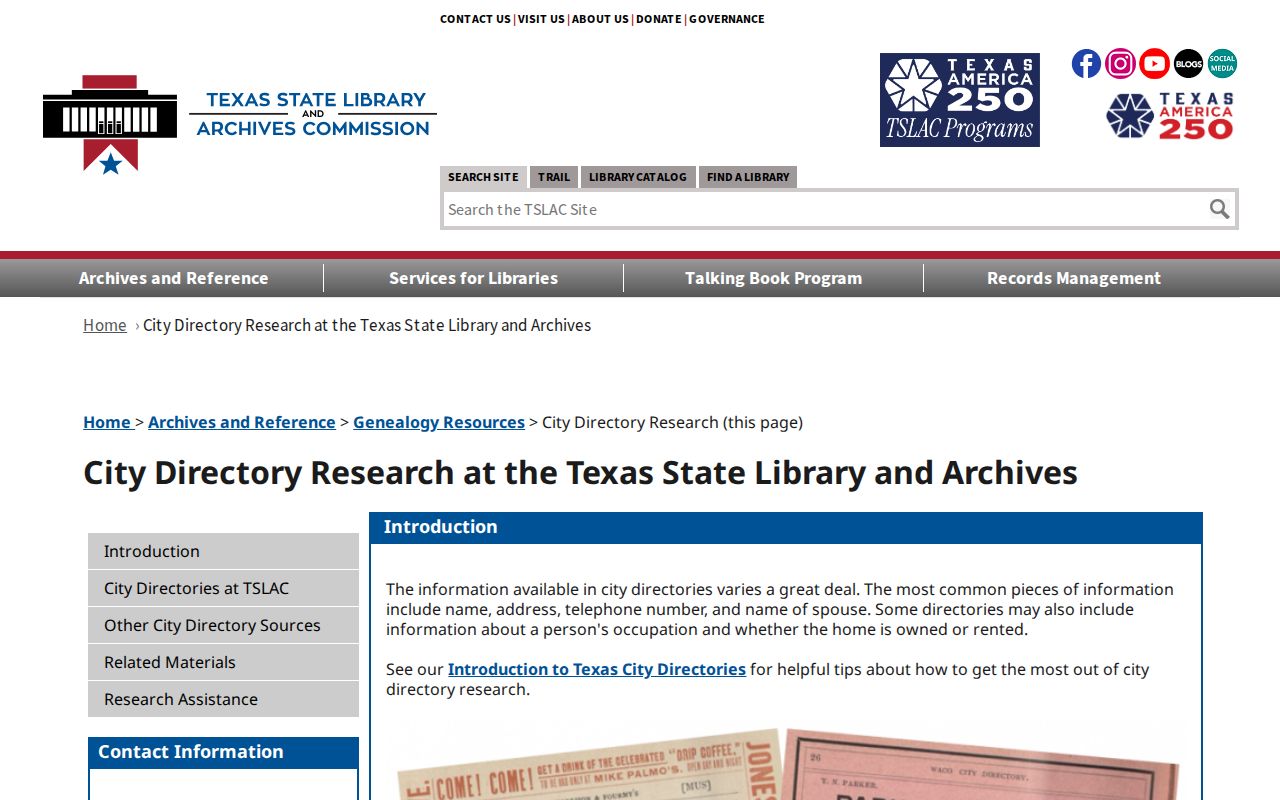
TSLAC directs researchers to its print and microform holdings in Austin and notes that staff do not perform remote searches or scans by phone or email. Record the edition and page before requesting any related item.
| Name | Surname and given name or initials, which may be abbreviated or indexed differently in later editions. |
|---|---|
| Address | Street, house number, rural-route wording, or a mailing-city form used by that volume. |
| Telephone | Subscriber number or exchange information, not a statement that every household member was listed. |
| Spouse notation | A relationship clue that should be compared with census, obituary, or probate material. |
| Business reference | Possible context from a city-directory entry, never a substitute for identifying the person. |
| Status mark | A notation that may appear in some directories and should be read with the volume’s key. |
- Criss-cross directory
- A street-order section that lists addresses rather than starting with a person’s name. No confirmed Midlothian run was located.
- Householder index
- An index arranged by the named household or subscriber, useful for reaching an address entry in the same volume.
- Abbreviation key
- The volume’s explanation of its short forms. Preserve it with the page image because an initial, widow notation, or business mark can change the reading.
Midlothian Directory Clues, Not Proof
A missing name in a Midlothian city directory does not establish that a person was absent. The number may have been unlisted, carried under another household member, connected to a business, placed under a different mailing city, or never installed. The same caution applies to an apparent address match. A telephone subscriber, an owner, and a person counted in a household can be three different people.
MYTH: A regional Greater Dallas White Pages page can contain a Midlothian entry without being a complete Midlothian household roll. Compare the entry with an independent, dated record.
Texas privacy protections also set a boundary. Do not republish sensitive identifiers or protected survivor information from a record image. A missing ordinary address can be an intentional safeguard rather than an error in the collection.
Midlothian Directory Timeline
The available record trail is uneven, but its milestones help prevent a modern-city assumption from being projected backward. Midlothian’s earlier post-office and railroad identity can appear under Barker or Ellis County wording. Regional directories, county-seat resources, and current library arrangements belong to different parts of that timeline.
- 1881–1888: Midlothian appears in local use, follows petition and lot-sale activity, and then incorporates. Earlier descriptions may instead use Barker, rail, or post-office language.
- 1885: A northern Texas telephone exchange directory includes Midlothian in an exchange list.
- 1895–1942: Documented Waxahachie directories provide county-seat context, but not a substitute Midlothian series.
- 1983–86: UNT holds digitized Greater Dallas White Pages examples with Midlothian-area entries.
- 2024: The stand-alone Midlothian Public Library opened at the current civic location after the earlier shared A.H. Meadows arrangement.
Note: No exact first or last printed Midlothian directory year was located, so a gap in this timeline should remain a documented gap.
Midlothian Directory Archive Hand-Off
The Midlothian Public Library is the direct local research contact at 215 N. 8th Street. Its published hours are Monday through Friday from 10 a.m. to 7 p.m. and Saturday from 10 a.m. to 4 p.m. Current cardholders can use TexShare databases with a password from the circulation desk. The library page does not identify a confirmed local directory, obituary, newspaper, or genealogy run, so ask for a reference interview and a finding aid instead of assuming a title is available.
The source image below links to the library’s current public page.
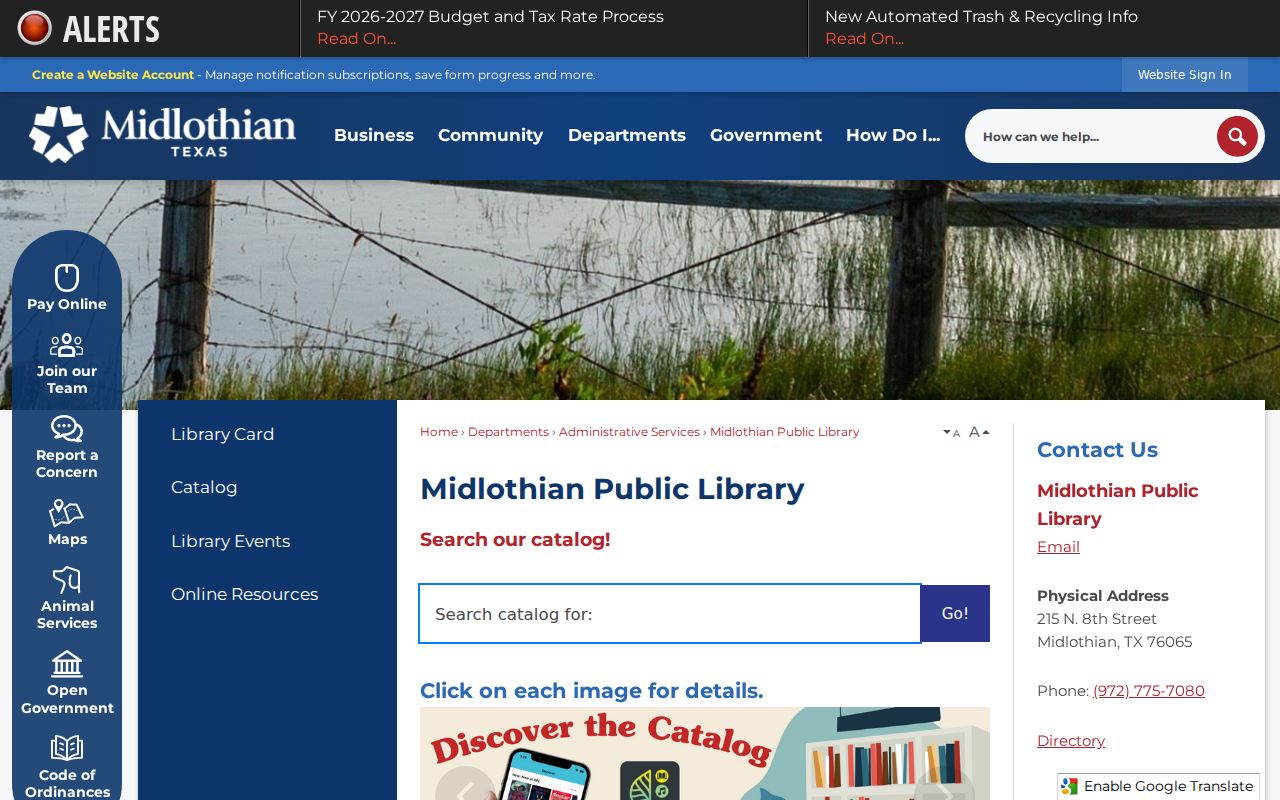
Its catalog and online resources are useful starting points, but older citations to A.H. Meadows may refer to the former shared school-library setting. Record the physical location and catalog or item address with every citation.
The city’s Midlothian Area Historical Society preserves photographs, documents, memorabilia, oral histories, historical surveys, and historic-structure information. The source image below links to that city page.
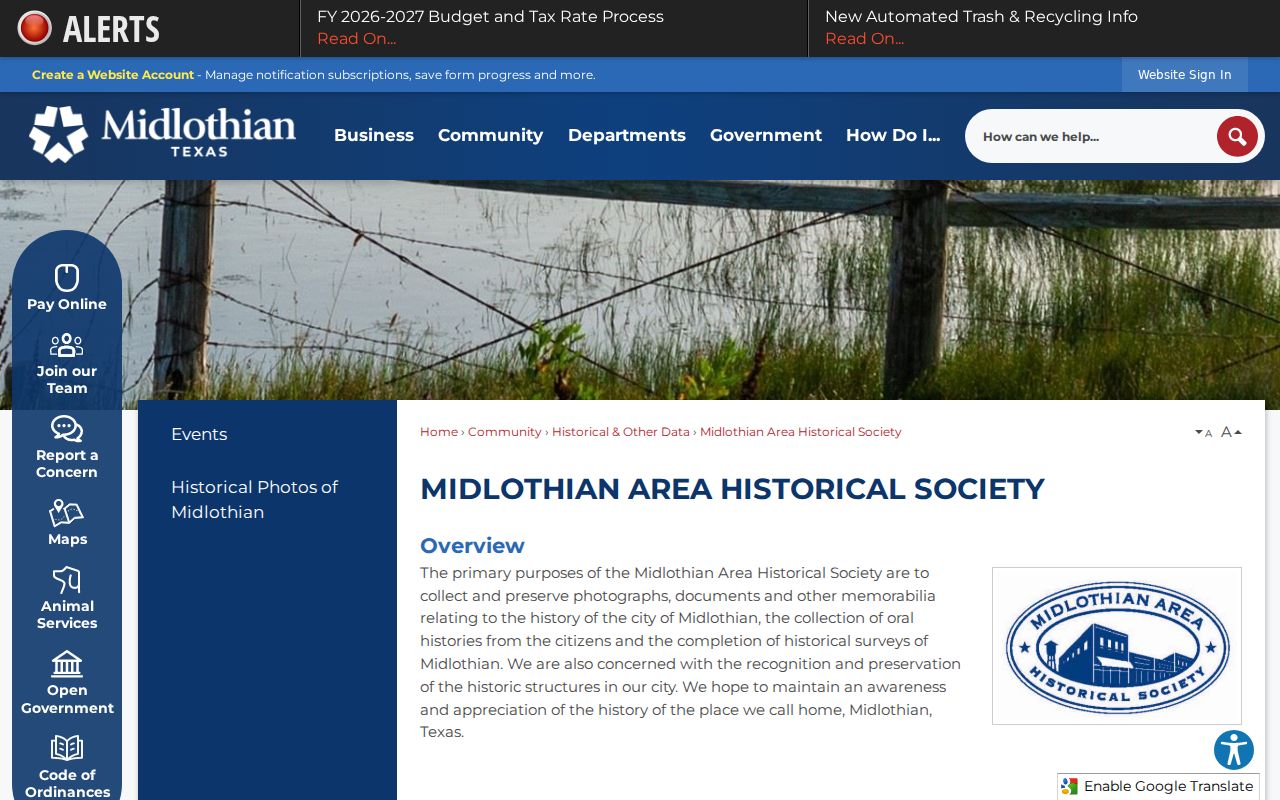
For surname files, photographs, vertical files, cemetery material, and local newspaper leads, the Ellis County Museum, Ellis County Genealogical Society, Sims Library, and UTA Arlington form a regional hand-off. Call ahead with a narrow surname, street, or year question, because no official local obituary or yearbook index was confirmed.
Midlothian City Directory Family Tracing
A household trail works best when every edition is treated as a dated observation. Start with the oldest confirmed page or volume, then compare spelling, initials, spouse wording, telephone exchange, and address on both sides of the date. The aim is to build a small evidence stack, not to fill a gap with a likely-looking name.
- Record the title, publisher or telephone company, edition month and year, page, surname, and given name exactly as printed.
- Copy the address, route, telephone information, spouse notation, business reference, ownership mark, and the abbreviation key if the volume supplies one.
- Search the preceding and following editions for changes in initials, street spelling, household wording, or the telephone exchange.
- Compare the address against the legal description and recorded transfers, especially when a street name or number has changed.
- Pair the directory year with the nearest available federal census, then use an obituary or probate record as a later endpoint where the evidence supports it.
A name that disappears may signal a move, death, unlisted telephone, new subscriber, or changed mailing city. Census and probate material can distinguish among those possibilities, but each needs its own date and citation.
Midlothian Directory Census Pairing
Federal census schedules are public through 1950 under the 72-year access rule. They capture a household on an enumeration date and can use a boundary that differs from present Midlothian. That makes them useful alongside a directory, not a current address source. A city-directory clue can narrow a surname or street, while the census adds a dated household composition. The two records should agree on enough details before they are treated as the same family.
For a question that moves from a historical listing to the present parcel record, use the Midlothian street address directory for the separate address-keyed trail. Keep the historical citation intact rather than replacing it with a modern address label.
Note: An enumeration date anchors a census household, but it cannot show continuous residence between two dated records.
Midlothian Directory Research Notes
Keep the source and the claim separate. A directory can support that a particular name, address wording, or telephone listing appeared in a stated edition. It cannot by itself settle full household membership, a precise move date, or continuous residence. Preserve the page image, catalog link, retrieval date, and the spelling used in the item. Search Barker, Midlothian, Ellis County, Waxahachie, and railroad or post-office terms when a nineteenth-century result seems to vanish.
When a record is absent online, ask the custodian or repository for the next physical or microfilm source. An unindexed book, a non-digitized series, a boundary change, a protected record, or a name variant can all explain an empty result.