
Midlothian Name-Record Coverage
One person can appear in several Midlothian records for very different reasons. An ECAD result identifies an assessment owner and separate situs and mailing fields. A deed records a party to a transfer. A voter result concerns registration, while a court result is an index lead for a case. Use the record that fits the question, then seek a second independent source before treating two same-name results as one person. This records coverage keeps a name search focused on what each custodian can actually confirm.
| Record | What It Confirms | Where | Access |
|---|---|---|---|
| ECAD parcel | Assessment owner, situs, mailing address, and parcel or legal ID | Ellis Central Appraisal District | Public web result; historical span not posted |
| Recorded document | Grantor or grantee role, instrument date, and legal description | Ellis County AcclaimWeb | Free index; images may require an account or transaction |
| Registration lookup | Status and election-jurisdiction context | Texas SOS | Free lookup; protected information is withheld |
| Court index | Party, cause or citation number, court, and status | Municipal Court, LGS, or Texas Courts | Index access varies; copies may carry a charge |
| Vital record | Event facts and an historical event lead | Texas DSHS or Ellis County Clerk | Age and requester rules apply to copies |
| License record | Credential type, number, expiration, and status | Texas TDLR | Public result; search requirements vary |
Begin with the least ambiguous official key. An address and legal description point toward ECAD and a recorded document. A current registration question belongs with the Texas SOS lookup. A case number belongs with the named court. An event date and county point toward a vital-record custodian. An entry is evidence of the displayed role at that time, not a complete profile of a Midlothian resident.
Midlothian Court Lookup Fields
Court searching is split by jurisdiction. Midlothian Municipal Court handles Class C misdemeanors within the city and has its own citation portal. County-level civil, criminal, and probate work begins through the Ellis County LGS entry point, while district civil, family, felony, and other district matters go through the District Clerk. Federal dockets sit in a separate Northern District of Texas system. Keep the court name and cause number with each result so an index hit is not mistaken for a full case file.
The Texas Courts citation search is shown here with its public controls.
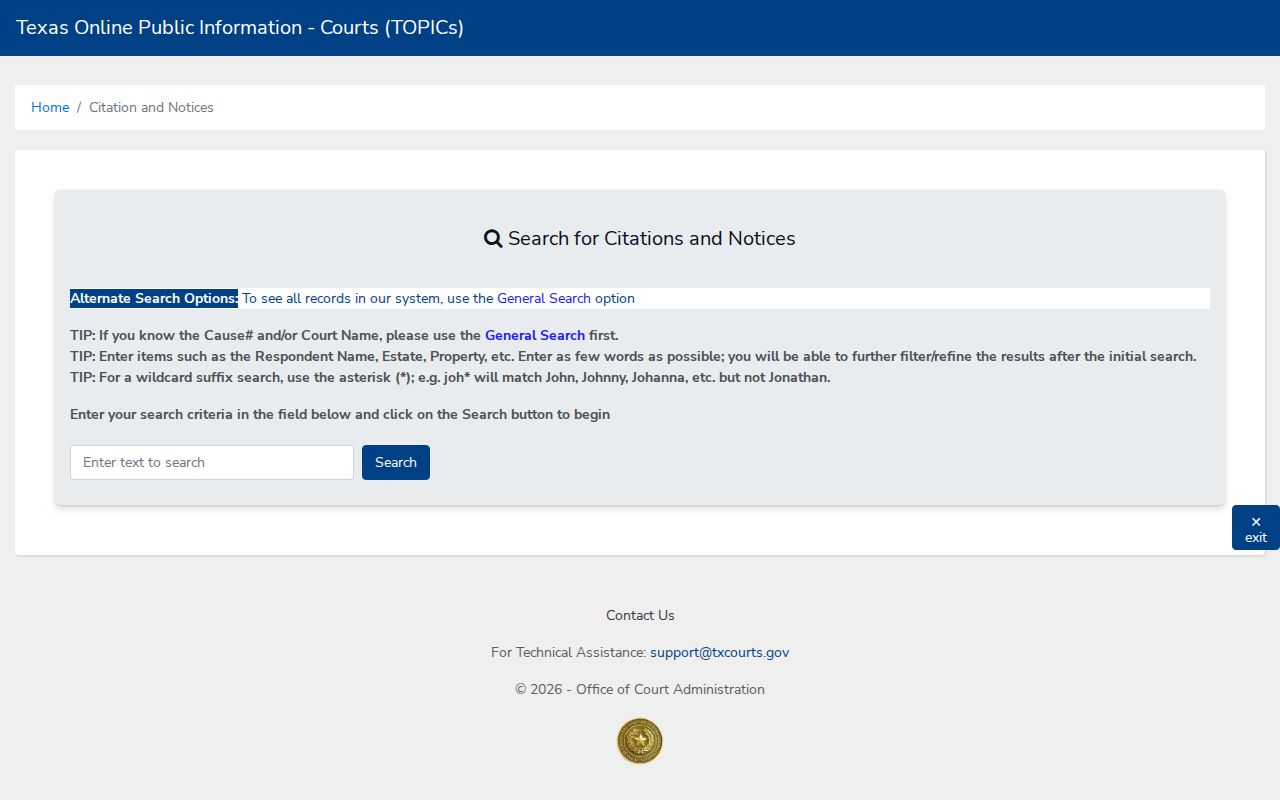
Its result headings are Name, Cause Number, Court/County, Status, and Action. Those fields give a lead to confirm with the court, not a substitute for the underlying docket.
| Field | How the official tool uses it |
|---|---|
| General search text | Accepts partial terms and an asterisk wildcard, such as joh*. |
| Name and cause number | Each can narrow the respondent, estate, property, or case lead. |
| Court/County and status | Optional filters that help distinguish similar names and result state. |
| Municipal name mode | Uses first and last name paired with date of birth; other modes use citation, license, plate, or business name. |
For a court index result, record the displayed party name, cause or citation number, court and county, record type, filing or issue date, status, action link, and any restriction notice. A clerk counter or public terminal may provide more than the web index. Ask the custodian whether an ordinary or certified copy is needed before requesting a cost estimate.
Note: Juvenile, sealed, expunged, adoption, and some family-law material are not ordinary public search results.
Midlothian Same-Name Checks
Names are weak identifiers on their own. Preserve the spelling returned by the source, then try surname-first and given-name-first forms, middle initials, suffixes, prior names, and an entity or trust form when appropriate. Compare the county, date sequence, court, parcel legal description, and the role printed by the source. A name on a deed can be a grantor or grantee. A name in a court index can be a party, not an address confirmation.
ECAD and AcclaimWeb solve different parts of the Midlothian problem. ECAD offers the current assessment owner, situs, mailing address, property ID, and legal description. AcclaimWeb gives the recorded trail, including the instrument date and party role. A homestead flag or mailing address is not a live list of everyone occupying the place. Treat it as one field to cross-check, not proof of occupancy.
Verify a Midlothian Resident
To look up a resident without joining mismatched records, start with one official result and add only sources that independently match it. This sequence is useful when a name is tied to a parcel, a court index, or a public event record. It keeps the address field, party role, and time marker separate until the evidence agrees.
- Search ECAD by the exact name or address. Save the property ID, legal description, situs field, mailing field, and retrieval date.
- Use the owner name as a grantee search in AcclaimWeb. Match the purchase deed by legal description and instrument date, not by name alone.
- Check the relevant court index with the name plus court or county context. Keep a cause number separate from the parcel record.
- For an event question, use the county clerk or DSHS process that fits the event and eligibility rules. Request a certified copy only from its custodian when one is actually needed.
A probate question may call for an estate file, where a testator, heirs, executor, attorney, residence clue, and instrument dates can be compared with a deed transfer. A former classmate is better approached through yearbooks, alumni material, library archives, or a dated directory than through a current-address assumption. Texas birth-parent questions use the authorized adoption registry or confidential-intermediary route, not a general birth-record request.
- Docket
- The court's running case record, which can list filings, events, parties, and status.
- Index versus image
- An index is a searchable list of record details; an image is the document view, which may have separate access or cost.
- Certified copy
- A copy issued or authenticated by the record custodian for a purpose that requires official certification.
Midlothian Voter Lookup Limits
The official Texas Am I Registered? lookup is a current-status tool, not a full voter-file display. A match can confirm registration status and election-jurisdiction context. A non-match can reflect a spelling issue, recent move, suspense or cancellation status, protected status, or a different county. It is not proof that a person has never been registered.
The Texas voter lookup begins with an identity prompt and may return status, effective date, precinct or districts, and limited residence or mailing context. Texas does not register voters by political party, and a participation record indicates only that a ballot was recorded in an election, never how it was marked.
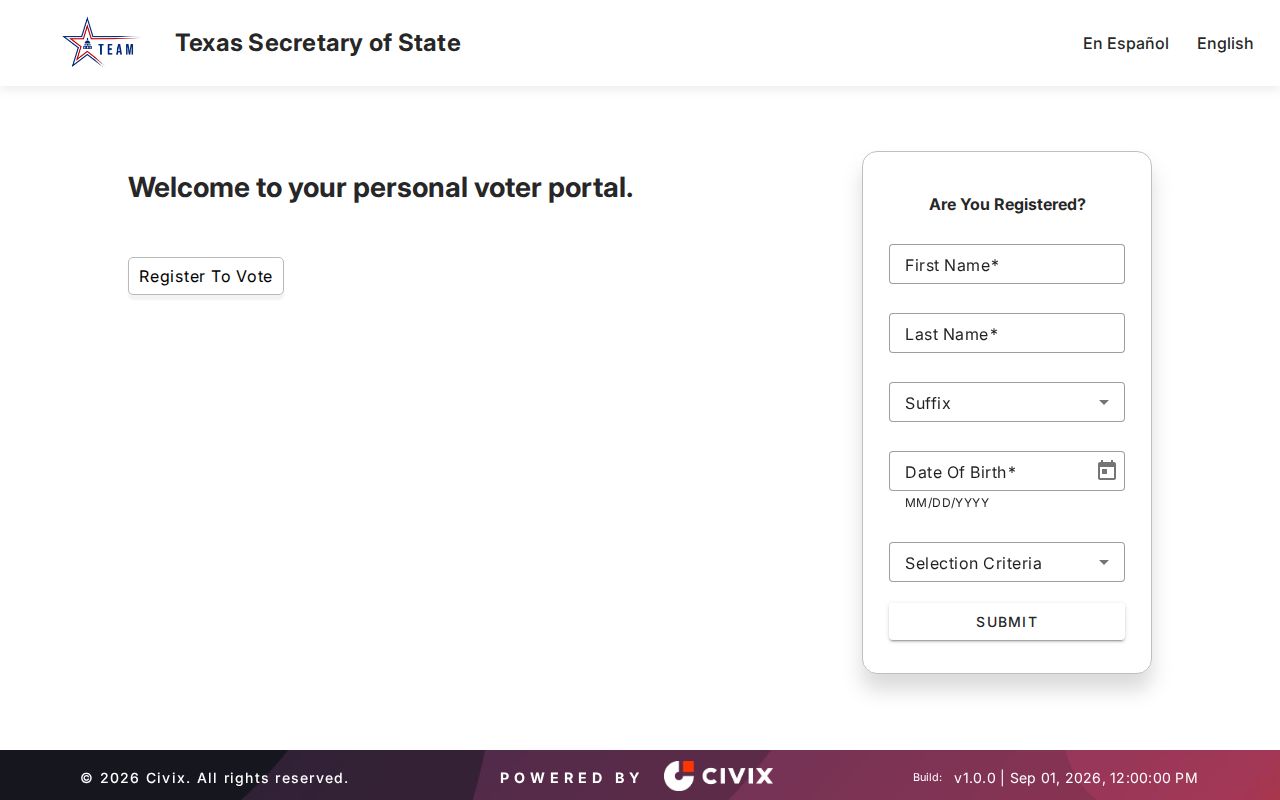
Telephone number, Social Security number, driver-license information, and full date of birth are not public result fields. Address-confidentiality rules can also limit the ordinary display.
Midlothian Vital Record Limits
Vital records establish an event, not a present residence. The Ellis County Clerk is the local custodian for birth and death certificates and says its birth records reach back to 1850. Statewide Texas DSHS birth records cover 1903 to the present. A death record from the local office concerns a death within Ellis County, so an Ellis County resident who died elsewhere may require the custodian where the event occurred.
Under Texas Government Code §552.115, birth records become public after 75 years and death records after 25 years. Before those thresholds, qualified family members, people with tangible interest, or other authorized requesters may need identity and supporting documents. A verification letter has limited event facts and is not a certified copy. Marriage licenses come from the county clerk, while a divorce decree is a district-court record.
The DSHS birth-record page shows the state ordering choices and eligibility information.
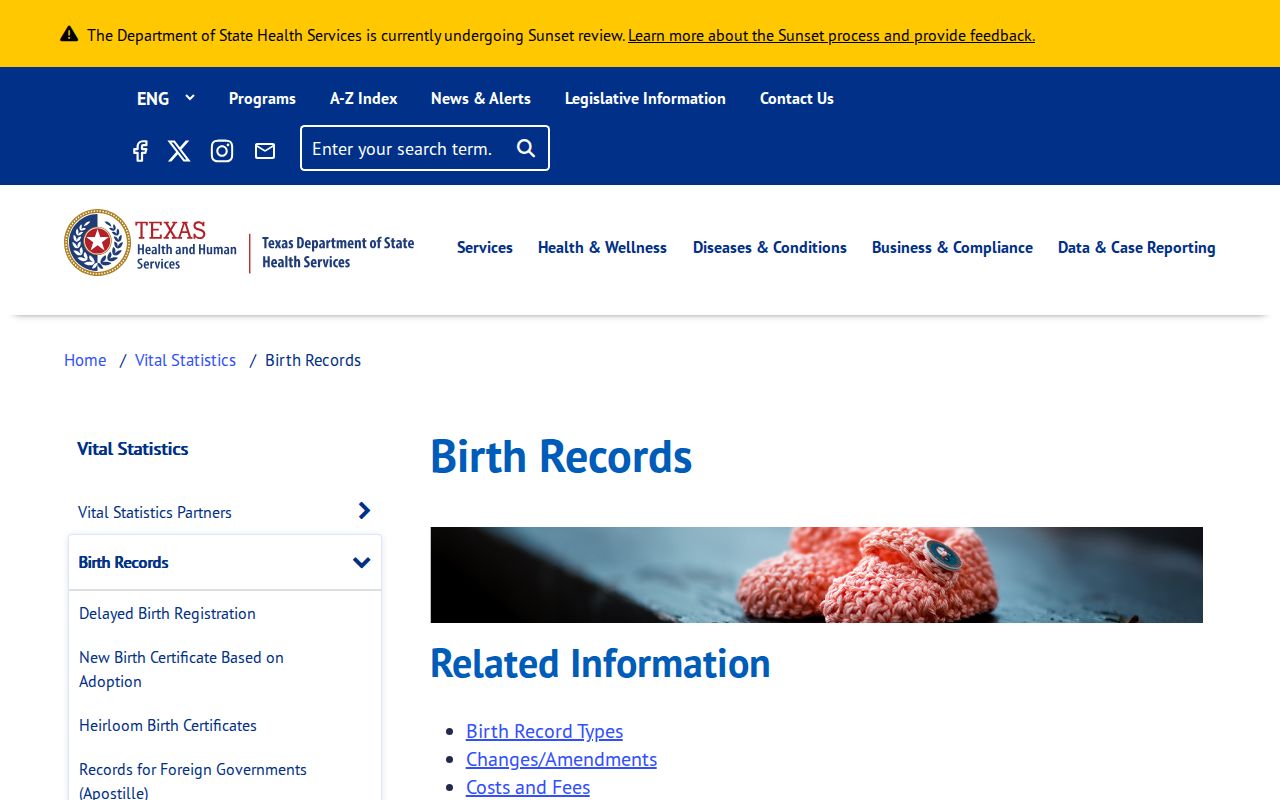
Texas.gov, mail, and in-person channels are documented for eligible birth-certificate orders. Current fees vary by order type, so check the live DSHS fee page before placing an order.
Midlothian Records Request Fallback
When an official index ends, request an existing record from the custodian rather than asking an office to compile a new personal dossier. The Midlothian public-information portal accepts written requests through an account that can track requests, download responses, and search archived requests. The City Secretary route is useful for city-held material when a department has no direct search screen. Police and EMS records have separate routes, and judicial records do not follow the ordinary city PIA path.
The Midlothian public-information portal describes the city process, including account-based request tracking and response downloads.
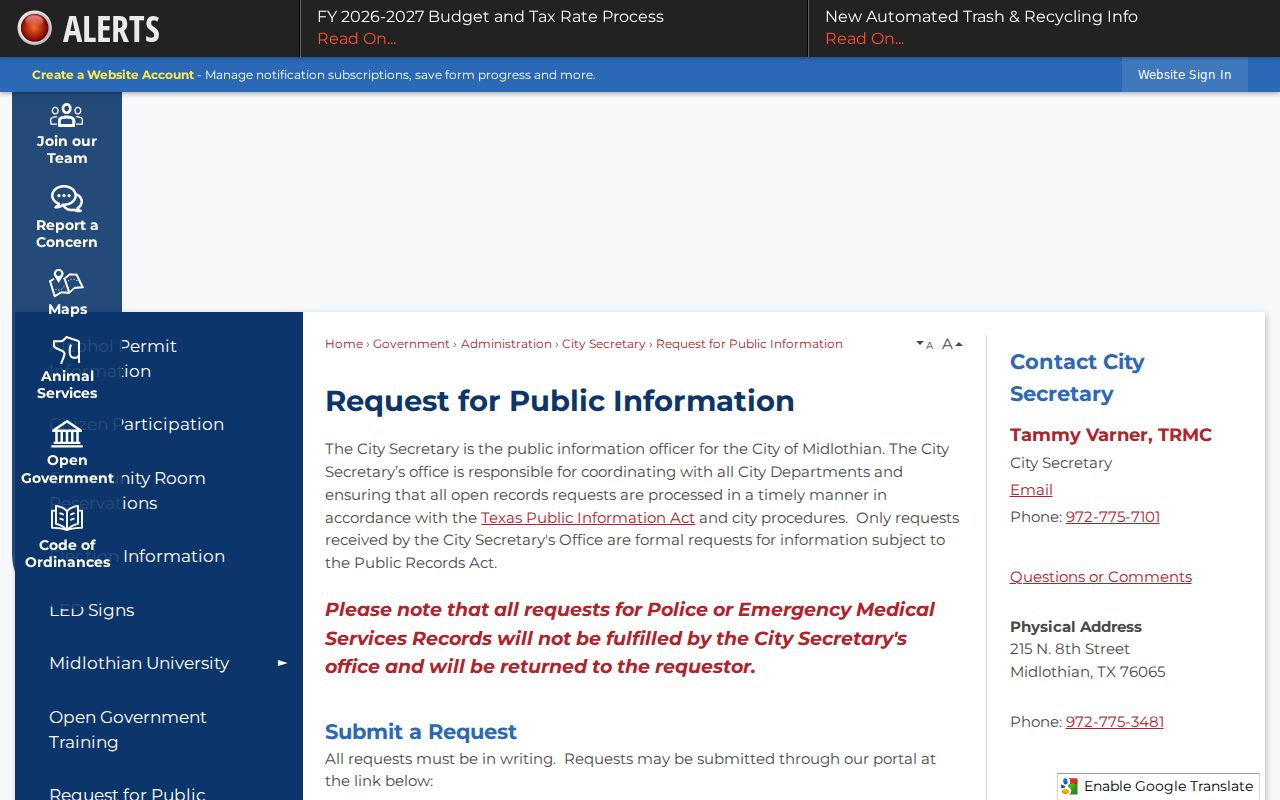
For judicial records, the city's form says requests go to the presiding judge under the applicable court rules. The city says it responds within 10 working days, subject to the PIA and record complexity. Texas Public Information Act requests seek existing records and do not require a government body to research a question, create a new database, or combine records from several systems. A narrow request can name an instrument number, cause number, parcel or geographic ID, date range, and preferred format. Ask for a cost estimate before a large production.
Midlothian License Lookup Context
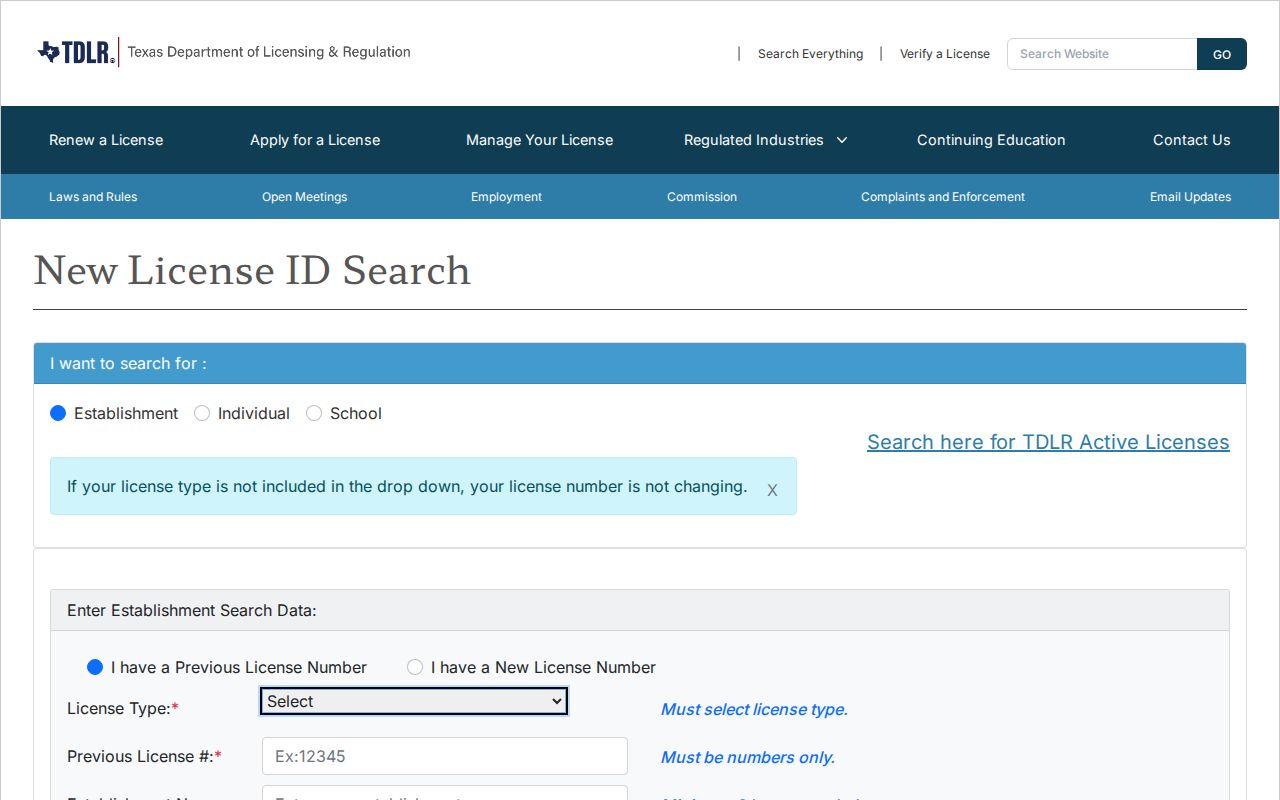
A credential record can confirm a public license relationship, but it does not establish a person's current home. Texas TDLR searches individuals, establishments, and schools by license type, previous or new license number, or an optional name, establishment, or school term of at least three letters. Results can show license number, expiration, type, name, and notes. Pair that dated result with the relevant custodian record before using it to distinguish a same-name person.
The official Texas TDLR license search is pictured below.
For an entity question, Texas SOS and county assumed-name records can document public filings. A UCC filing or an old license can show a filing or credential history, not a present Midlothian connection.
Note: Keep a rejected-result column in a search log so one stale filing cannot become a current-person claim.
Midlothian Record Access Limits
Texas records have meaningful access boundaries. The Address Confidentiality Program can give eligible survivors a substitute mailing address, and confidential voter procedures restrict ordinary display of protected address information. Sealed, juvenile, expunged, adoption, and restricted court material should not be pursued through another record system. The Driver's Privacy Protection Act separately limits motor-vehicle personal data. An absent ordinary address result can be an intentional protection, not an error.
If a public instrument, case, or parcel display appears to reveal sensitive information, give the custodian its exact number and ask whether a statutory redaction process applies. Do not send unredacted identity documents unless official instructions require them. Texas Penal Code §42.072 addresses stalking and §42.07 addresses harassment, so the safest practice is to minimize copied personal information and stop contact when asked.
Lawful use. Use official name and address records for lawful personal, family-history, civic, or property-history research. Do not use records to stalk, harass, threaten, intimidate, or harm anyone.